
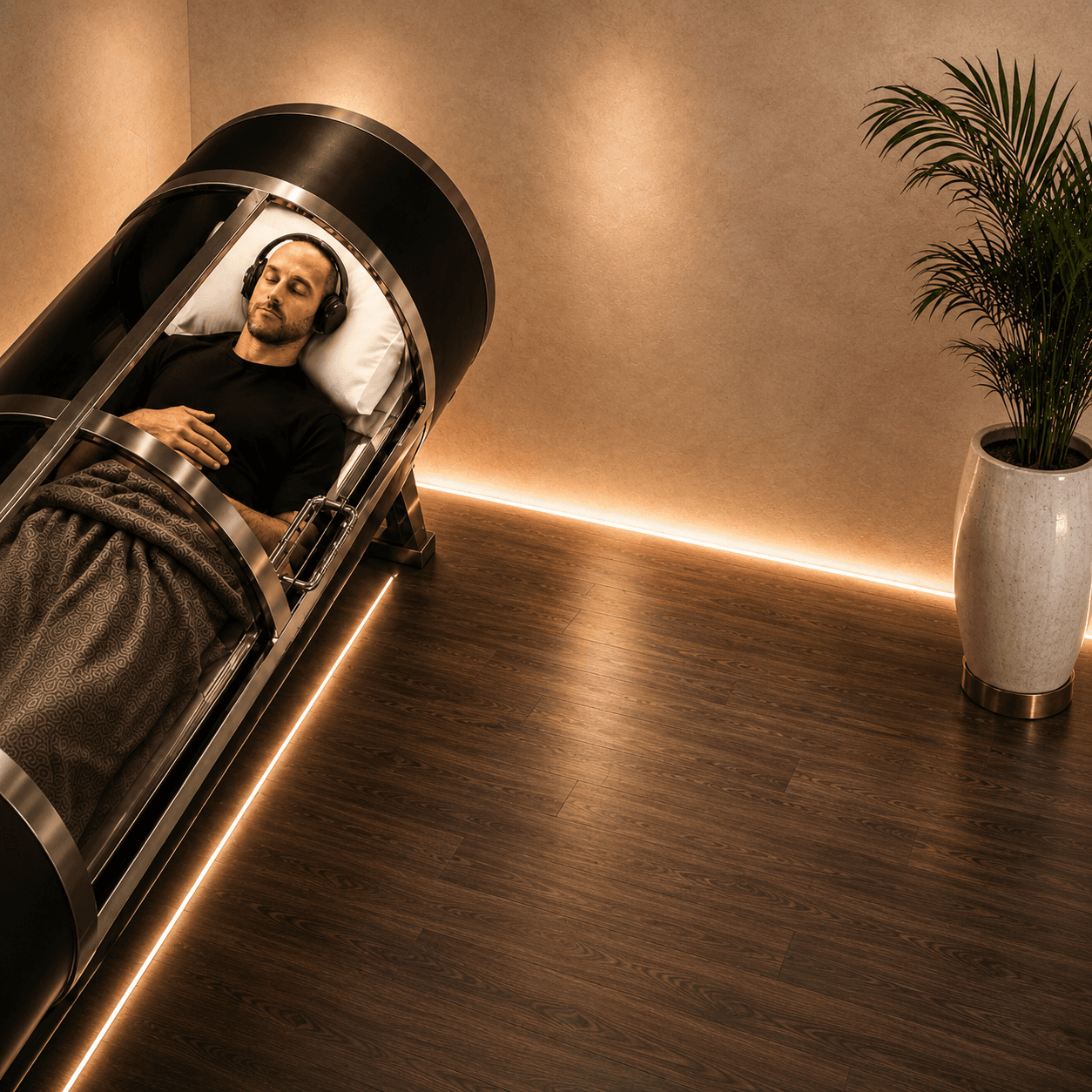
Short answer: start with a few sessions close together, then find a weekly slot you can keep. Our guidance for general wellbeing is one or two sessions a week, and the clients who get the most from hyperbaric oxygen therapy are not the ones who do the most sessions — they are the ones who never let the habit lapse.
The short answer
- To begin: two or three sessions in your first two weeks.
- Then: one session a week, the same slot each week. Two if you want it and your diary allows.
- Not: a session every few months when you remember. The hour is a pause, not something you can stockpile.
Every session is the same shape — 45 minutes at a mild 1.35 ATA inside a private AirPod, an hour door to door, no mask and no bottled oxygen — which is exactly what makes it easy to build a routine around. If you have not been yet, what to expect at your first session covers the hour itself. This guide is about what comes after it.
Why the first fortnight matters
The first session is about the pod, not about you. You are learning how your ears respond to the pressurisation, which setting suits you, whether you want to read, work or sleep. That is normal and it is why we tell everyone: give it three.
Spacing those first sessions close together — say, two in the first week and one in the second — means each one builds on the last while it is still fresh. Leave a month between your first and second and you spend the second session re-learning what you already knew. By the third session the hour is yours, and only then can you judge honestly how the routine fits your week.
More is not better past a point. Consistency is. A weekly hour you keep for a year does far more for how your weeks feel than a heroic block you abandon in month two.
What a weekly rhythm looks like
Treat it like a standing appointment, because that is what makes it stick. Pick a slot and keep it: the same day, the same time, in the diary before anything else lands on it. Clients who float the session around their week are the ones who quietly stop coming; clients with “the Tuesday hour” are still here a year later.
Late afternoon and early evening are the most popular slots for a reason. After the first few sessions some people feel sleepy later that evening, so a session that ends as the working day winds down lets the calm carry into the night rather than the afternoon. If you want the hour as a reset before the week starts, a Sunday session does the same job from the other end.
Bring what you want the hour to be. A book makes it reading time; headphones make it a podcast hour; nothing at all makes it a nap. Phones come in with you, so the choice is genuinely yours — but the clients who describe the session most warmly are the ones who leave the phone face down.
Pairing it with cryotherapy
The two therapies suit each other because they are opposites. Whole-body cryotherapy is three minutes, cold and bracing; hyperbaric is an hour, warm and still. The classic order in a single visit is cryotherapy first and hyperbaric after: the jolt, then the calm.
You do not have to do both in one visit. Plenty of clients split them — cryotherapy mid-week when they want the lift, hyperbaric at the end of it when they want the pause. The point is the same: one short reset and one quiet hour in every week. That combination is what most people settle on, which is why our Longevity plan is built around exactly that pairing.
Signs it is working for you
Because this is a wellness routine rather than a course of treatment, the measure is how your week feels, not a number on a chart. The signs clients report most are simple ones:
- You look forward to it. The hour has become the one slot nobody else can reach you in.
- The calm lasts into the evening — and, after the first few sessions, into a good night’s sleep.
- Your ears clear without thinking about it. The pressurisation that took concentration in week one is automatic by week four.
- You have stopped negotiating with yourself about whether to go. It is simply what Tuesdays are.
And if it is not landing — if you are forcing yourself in, or your ears are still slow to clear after several sessions — say so. The team can slow the pressurisation, adjust the pressure or suggest a different rhythm. Hyperbaric is not suitable for everyone, which is why we ask a few screening questions before your first session.
Which plan fits which rhythm
- Trying it once — the £39 intro session, for new clients only, is the cheapest way to find out whether it is for you.
- Finding your feet — a pack of ten brings each session to under £39 and stays valid for four months, so those closely spaced first sessions and an irregular diary both fit.
- A weekly habit — the Club plan gives you four sessions every four weeks at a lower monthly outlay: the standing appointment, paid for once.
- Both therapies — Longevity pairs one cryotherapy and one hyperbaric session a week. Limitless removes the cap on both if you want more than that.
Memberships are rolling and can be paused, so a holiday does not break the habit; every price is on the pricing page, and the same prices apply in clinic and online. If you are nearby, our Canary Wharf page has directions and opening hours.
Common questions
How often should you do hyperbaric oxygen therapy?
For general wellbeing, our guidance is one or two sessions a week. Start with two or three sessions in your first fortnight to learn the pod, then settle into a fixed weekly slot. Consistency matters more than volume.
Is once a week enough?
For most clients, yes — one protected hour a week is the rhythm people keep longest, and keeping it is what counts. Some prefer two sessions a week; more than that rarely adds anything for a wellness routine.
Can you do hyperbaric oxygen therapy every day?
Sessions on consecutive days are fine in the first fortnight, when they help you get comfortable quickly. As an ongoing routine, daily sessions are more than most people need — a weekly rhythm you actually keep beats an intensive block you abandon.
How many sessions before I know whether it is for me?
Give it three. The first session is about the pod — the ears, the pressurisation, deciding what to do with the time. By the third, the hour is yours and you can judge how the routine fits your week.
Can I do cryotherapy and hyperbaric on the same day?
Yes. Cryotherapy first and hyperbaric after is the classic order: the three-minute cold reset, then the quiet hour. The Longevity plan is built around exactly that pairing, once a week.
What is the best time of day for a session?
Late afternoon or early evening is the most popular slot. Some clients feel sleepy later that evening after the first few sessions, so a session that ends as the day winds down fits well. Whatever slot you choose, keep it the same each week.
What if I travel or miss a week?
Nothing is lost — pick the rhythm back up. Memberships are rolling and can be paused, and a pack of ten stays valid for four months, so an irregular diary still fits.